Railway Heritage

Sandstone starts to move its valuable 3’6” coaches under cover

Sandstone starts to move its valuable 3’6” coaches under cover

The erection of a 150-metre long carriage and wagon shed has enabled us to start using our valuable 3’6” coaches under cover.

These wooden bodied coaches which comprise pillared dining cars, kitchen cars, lounge cars, and sleepers are very susceptible to the extreme temperature changes in the Eastern Free State. Although it is a very dry climate and it is very kind to metal it is less kind to wood. It is important therefore that these be put under cover to protect them from weather and from the UV that they are subjected to.

This is a major operation involving all our own manpower and resources.

The photographs tell the story.

CR W01

CR W02

CR W03

CR W04

CR W05

CR W06


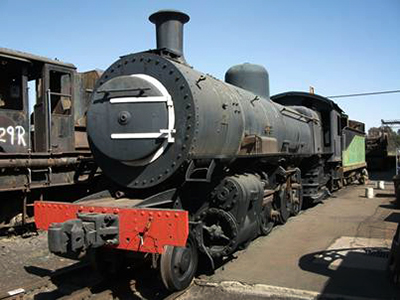
Our Class 11, No. 929, receives TLC from Bloemfontein Works

Sandstone Estates is very proud to have been able to acquire the Class 11 locomotive, No. 929, from the North British Preservation Group in the UK. Fortunately the locomotive was already located adjacent to our Bloemfontein Works so being able to incorporate it into our work programme was simple.

Lukas Nel has sent us this photograph of the locomotive with the following comments:
“We still cleaning and paint our class 11. Still a long way to go.”

image001-1

Loco Pit

Loco Pit

Wouter and his team have been carrying out a massive cosmetic exercise on the running shed.

These pictures show the pristine state of the loco pit.

image001

image002

Restoration project continues for DZ's

Restoration project continues for DZ's

We have always preferred the DZ's to all the other freight wagons due to their versatility. We have four unrestored units photographed below which will be restored during the next 12-months or so.

RWP 1

RWP 2

RWP 3

RWP 4

The Bloemfontein workshops takes time off from restoring steam engines.

Lukas Nel has sent us these two pictures of the pump trolley and wagons that are being built so that we can operate the railway line without the assistance of coal mines.

Lukas still has to add some supports and paint the trolleys to complete the project but as always it has been done well, been done quickly, and been done with flair. Well done Lukas and team!

W 01

Coal sieve

Coal sieve

Our engineering chaps have built and commissioned a Coal sieve which will come in useful trying
to keep our coal relatively dust free.

Coal sieve


Running Shed

Running Shed

Wouter Jubileus and his team have been very creative recently in making the Running Shed at Hoekfontein a more pleasant place to work.

These initiatives were entirely self-motivated by the team in the workshops.

RS 03

Wouter Jubileus with his creative idea of mounting a non-standard Coco pan as a display.

RS 01

Two more passenger coaches are under construction which will be specifically designed to operate with Little Bess and our Decauville locomotive. Each of these carries about
10 people and it makes for a very relaxing trip through the African savannah.

RS 02

Note the neatly painted floors in the background. Again, thanks to Wouter and his team.

An authentic dining experience

An authentic dining experience

It is possible to dine in an original 1920’s South African Railway pillared dining car during our annual Sandstone event. Notwithstanding the fact that this wonderful old dining coach is stationary it still has enormous ambience.

Dining experience

Hand Operated Crane

Hand Operated Crane

On one of our farms is a very interesting hand operated crane, obviously designed for lifting sandstone blocks onto railway trucks at the siding nearby.

It is in almost perfect condition and probably hasn’t been used for 50-years or more.  It is currently being relocated to the main complex, together with its magnificent sandstone blocks.

RW 01

RW 02

RW 03

Pump Trolley

The Bloemfontein workshops are becoming very creative and have now commenced construction of a Pump Trolley. These are ubiquitous in Railway history circles and came in  many shapes and sizes.

We have struggled long and hard to find an original which has been partly successful.  We know of one but we have not been able to acquire it at this point so rather than wait any longer we are building our own. The basic chassis and wheels for a new one have already been sourced and we will keep our readers updated regarding the progress.

Bloem 1

O&K Locomotive, No. 12691

At the heart of every locomotive of course is its boiler.

The photos below show the state of the boiler for No. 12691. 
Most of the outside repairs are now done and work can start on the firebox end
tube plate next week.

sandstone-rail-bicycle-013


Bloemfontein report on Avonside locomotive, No. 1624

An enormous amount of work is still being done on the boiler.  The photo below is of a boiler patch fitted to secure the safety valves.  This still needs to be riveted to the boiler and holes drilled to the studs to secure the safety valve as well as the supply hole.

sandstone-rail-bicycle-008

O&K Locomotive, No. 12691, under restoration at Bloemfontein.

Restoration01

We tend to publish pictures on our web site of the work that Lukas Nel does very often showing work in progress which clearly indicates an advanced stage of repair of various components. In most cases we are actually rebuilding them completely.

Avonside locomotive boiler

Sandstone Heritage Trust's Bloemfontein workshop has received the tubes for the Avonside locomotive boiler  No. 1624, ex SANRASM. Lukas Nel has submitted some excellent photos of Izak expanding the tubes at the firebox tube-plate .

 In this photo we see  Isak swaging  the boiler tubes on the swage machine.
 
 Sandstone-W4


Angolan O&K - Feldbahn Museum

Angolan O&K - Feldbahn Museum

Saturday was one of three open days at the Feldbahnmuseum 500 e.V., located in a rural suburb south of Nüremberg. I had to walk 10 minutes from the bus stop to get there and was surprised to find lots of cars parked outside the place. CFF 764.376 (Resita 1957, ex Viseu de Sus) is plinthed at the gate together with the body of a DR covered wagon from Radebeul. I was later told that the Romanian loco had been acquired from CFI Criscior to be exchanged against the little Krauss that was back then part of the Marxzell collection/scrapheap. As the owner of the stuff at Marxzell didn’t want to sell the Krauss, the idea was to exchange it against another steam loco. After the Resita had been acquired he however changed his mind and sold the Krauss, the Resita stayed in the hands of the FM500. Inside, behind the brand-new storage building/museum hall, I was surprised to find that the whole railway is in fact built on a steep slope, with a steeply-graded line connecting the lower section and private garden railway with the upper loop. See http://www.feldbahn500.de/gleisplan_frameset.htm for a map of the railway. As everything is in the forest, only the plinthed Resita at the entrance can be seen on Google Earth. The big blue building at the bottom left is a museum and not (yet) connected to the railway. The roundhouse and two more sheds are in the garden of a private house and not accessible to visitors. The green and yellow buildings are temporary structures to eventually be replaced by permanent ones. A lot of space is needed to house the large collection of locos, which next to the two steam locos includes a compressed air loco, an electric loco, a petrol loco, 16 battery locos, 44 diesel locos, 2 monorail diesel locos and 408 wagons. After being welcomed by the lady who had taken my reservation on the phone, I made my way up the hill to the operating loop, where I could hear the Angolan O&K make it’s rounds.

Compania do Assucar de Angola (CAA) O&K 0-6-0T 12493/1934 (30 PS, 6.5t) used to operate at Tentativa sugar mill in Caixito, c. 60 km NE of Luanda. In the late 60s the mill had three of the 0-6-0Ts and nine diesels operational. No. 12493 together with another two locos of the same type (11112/1925 & 12140/1930) and a smaller 0-4-0T (10311/1922, 10 PS) were bought by Sandstone and shipped to South Africa. They were all in very poor condition, but have or are currently being restored to working order by Lukas Nel at Bloemfontein, with none of the drawings available to him. No. 10311, regauged to 24-in., was put back into service in April 2011, while No. 12493 was rebuilt and sold to the FM500 via Rüdiger Fach. The two other locos have also been regauged and are nearing completion.

The steam loco, hauling three purposedly-built passenger cars, was doing 2-3x 3 rounds on the upper loop before being taken out for water and servicing. During those times a Diema diesel was used with a rake of five small open cars. Before the completion of the passenger cars, three underground miner’s cars were used behind the steam loco.

I befriended whom I thought was one of the members of the FM500 Society, a Macedonian from Greece who was acting as a crossing keeper. He was keen to show me locos and equipment in the cordoned-off parts of the railway and when I asked him how many members the society had, he told me six. “Six, then it’s a very small society?” –“No, six full time employees”. It turns out the railway was started in 1976 by Karl Heinz Rohrwild, owner of the Dorfner Group, a 225 Million Euro company founded in 1949 and active in building cleaning, building management and catering. The group currently has over 10,000 active employees in Germany, Austria, the Czech Republic and Poland. KH’s passion were 500mm gauge underground mining railways and as a result the major part of the loco collection comes from that area, from Germany, the Czech Rep. and Switzerland. Karl Heinz did all work on his railway by himself and in 2005 one of the locos he saved from certain death at the hands of the scrapman, a 6-ton beast, turned against him and run him over on the steeply-graded track left of the museum building. The Killer loco is still on site, next to the track and covered by a tarp. His sons decided to keep the railway and now employ six people permanently for trackwork, repairs and restoration of the rolling stock and to remove leaves and snow from the premises during the winter (for the snow they have an rotary snowplow – pics. 6709/6713).

The little inside-framed MÜNCHEN (Krauss No. 5745/1908, 20 PS, 4.9t) formerly operated at the Ludovici tile works near Mannheim. After the tile works were closed it spent years at Marxzell. KH had for a long time dreamed of acquiring it, but it was only after his that his son was able to buy it have it restored. It has been operational since 2009.

I got to talk to his son Karl Heinz’s son, Karlheinz Rohrwild, who now heads both FM500 and the Dorfner Group. He showed me all the locos I was interested to see. He lives in the 2nd house to the left of the museum compound (the one with the roundhouse in the garden), while Karl Heinz’s widow lives in the house to the far right. The house to the left is also owned by the family, but has been rented out. At the top of the slope the family has acquired some more land onto which they hope to extend the railway, but still need the permission from the local authorities. No locos can operate on the steeply-graded track connecting the bottom and top sections, when locos need to be taken up or down they are hauled via a cable by battery loco at the top.

As it runs mostly through the forest, photography is challenging and the settings on my camera must have been wrong as most of my non-sunny pictures were washy. There is a small pond along the track, a small bridge and luckily at the far right side of the loop, where the line runs on a gradient, there is a large clearing which allows sunny shots in the afternoon.

My new Greek friend told me that FM500 operates charter trains for small groups. Sadly, the large wagon collection does not include any cane wagons, but I guess a long rake of tipper wagons behind the O&K would also do

Clck here to read more: http://www.feldbahn500.de/index.htm.


Article by: Thomas Kautzor


museum 1

museum 2

museum 3

museum 4

museum 5

museum 6

museum 7

museum 8

museum 9

museum 10

museum 11

museum 12

museum 13

museum 14

museum 15

museum 16

museum 17

museum 18

museum 19