Railway Heritage

RN 254 - Weekly steamshed report. 25 September - 02nd October 2006 - By Gert Jubileus

Sandstone Heritage Trust - Rail News
RN 254 - Weekly steamshed report. 25 September - 02nd October 2006 - By Gert Jubileus

2nd October 2006


1
This week we steamed the class NGG 13 number 49 to shunt the loaded wagons from Pandora pond to Hoekfontein Station where we will offload the wagons next week.
Derrick filled the boiler with water and prepared the locomotive for a hard days work in the shunting yard at Hoekfontein Station.

Below: Derrick filling the boiler of 49.

2


She was in Steam at 11H00 Thursday morning, and we first had a three-hour shunt in Hoekfontein to shunt all the Port Shepstone wagons into the storage line and to shunt out two wagons that will undergo restoration very soon.

3
4
5
6

At 13H30 we were finished with the shunting work that was needed to clear the main lines in Hoekfontein Station and we replenished 49's thirst before we departed for Pandora.

7

The nineteen wagons were split into two separate trains and with the first train; we hauled seven loaded wagons to Hoekfontein Station.

8
9

We again topped up the water before we returned to haul the last 12 wagons to Hoekfontein.

10
11

All the brakes were loosened and a vacuum brake test was done on the wagons before departure to Hoekfontein Station. Derrick had to shovel lots of coal into the firebox of 49 before we could depart and he made sure that she was hot.

12
13

We had the Orange Express headboard on the front of the Locomotive, but there was no way that we could keep up with the Orange Express timetable for the load was heavy, but 49 proved herself again and even though we were running at a walking pace of three km/h at some of the gradients, full open regulator without slipping, she managed to reach Hoekfontein Station just before sunset.

14
15

SANDSTONE STEAM LOCOMOTIVES:
THE RATANGA LOCOMOTIVE
This week Henry removed the driver wheels of this little locomotive and he descaled the wheels.
The frame will now be sandblasted.

Below: Henry busy with the restoration of this little locomotive.
16
17

CLASS 10CR
Because of the hidden level crossing behind the consist of the Class 10Cr, we had to move the massive locomotive ten meters forward to make the crossing more visible for vehicles traveling over it.
We used a huge tractor to move the 10Cr.

Below are some photos taken of the moving of the 10Cr.

18
19
20

THE FUNKEY DIESEL LOCOMOTIVE:
This week we offloaded the Funkey Diesel locomotive.
21
22

This little Diesel locomotive will come very handy to assist us with the shunting of the wagons while the Hunslet is in Port Shepstone. We used her to shunt down the gorgeous modified B wagon as well as an ST wagon that will undergo restoration very soon.

Below are photos of the offloading of another load of wagons from Port Shepstone, as well as the shunting operations with the Funkey.
23
24
Below right: A photo of the inside of the modified B wagon.
25
26
27
28

SANDSTONE WAGON REPORT:
THE XC
This week the XC wagon was painted with Red Oxide for an undercoat and the paint work will be finished during the next week when the XC will be shunted to the pit for a under frame restoration.

The wind was blowing like hell this week and it was a waste to even try to spray paint this wagon.
We instead used a roller to give the wagon an undercoat to prevent it from rusting until we can spraypaint it.

30_1
29

ST NUMBER 622
This week we lifted the wagon and rolled the bogeys back underneath the wagon to make it mobile again. This wagon will now undergo an under frame restoration and the new steel sides will be made.
Below are photos of this wagon.

30
31

STORAGE LINE
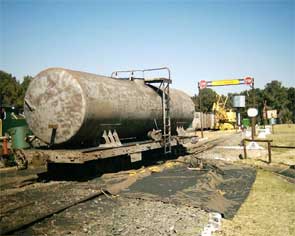
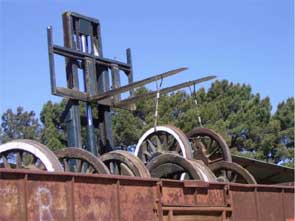
Henry and Oupa laid sleepers next to the Black water tank wagon and brought ten rails for this storage line that will be used to store the 3”6” bogeys and wheels on.

32
Past
33
Class 16Cr, St Helena number 1, now at Sandstone Estates. In front of her a pair of 14CRb locomotives can be seen, accidentally cut up in 1998. Three Class 16Cr locomotives were sold for scrap, but the two 14CRb locomotives were sold to a private collector. One of the Class 14CRb locomotives was still complete at that time.

The new Locomotive foreman of St Helena decided one morning that the three 16CR locomotives together with the two 14CRB locomotives should be shunted out of the Locomotive yard. For me, it was the worst job someone can ever give me, to shunt locomotives out to be cut up. It was if these locomotives knew what’s going to happen to them and I could hardly manage to shunt them out. Their big driver wheels just refused to turn along. One of the three 16CR locomotives was my first regular locomotive when I started to work at St Helena Gold Mine in 1993. In August 1998 the three 16CR locomotives were cut up, and one night the scrap dealers worked throughout the night and accidentally cut the boilers of both the 14CRb locomotives that were sold to the Private collector.
PLANNING FOR NEXT WEEK

1.) Load the bogeys for the trip to Durban.
2.) Go on with the restoration of the XC and ST 622
3.) Offload the wagons from Pandora.
4.) Erect the Semaphore signals at Hoekfontein Station.
5.) Weed spraying on the Railway line.
6.) Start with restoration of B wagon 2422.
7.) The repair work on No.153.
8.) Make the numbers for the points
9.) Start the restoration pf Home signal for Hoekfontein
10.) Stencil the wagons.
11.) Ballast the storage line
12.) Fit the softeners
13.) Fit the Softeners.
14.) Fit the Ejector onto the Peckett.
15.) Finish the War Van.
16.) Clean the passenger coaches.
Greet

RN 255 - Funkey 4WDH Underground locomotive

Sandstone Heritage Trust - Rail News

RN 255 - Funkey 4WDH Underground locomotive

3rd October 2006

Little is known about this diminutive loco which was bought at an Impala Platinum Mines auction along with a number of other ex mine locos. It is fitted with a Gardiner 3LW 3-cylinder diesel engine and has air brakes on the loco. In true vintage style it is started by means of a crank handle. Also finished in beige and red it is used for light shunting. It has just returned from Zach van Staden's workshop for a major service.
Now back at Sandstone to resume her light shunting services.

RN_255_01

RN 256 - Update on the Bagnall's restoration

Sandstone Heritage Trust - Rail News

RN 256 - Update on the Bagnall's restoration

3rd October 2006

The badly rusted and by most accounts totally derelict and irrepairable Bagnall locomotives Nos. 9, 10 & 11, are still receiving the sort of meticulous attention that is needed to bring them; one-by-one back to full working order.
Zach van Straden has sent us the following comments:

"The pistons have been fitted as have the cylinder heads - one will have to be removed again tomorrow to fix a misalignment on the manifold. The current problem is the injector pump - pictures herewith - which as you can see - like its mates from Port Shepstone is very badly rusted. Sadly however it has been informed that this condition is no passport to an early retirement to the nearest scrap yard (I am much older and still working!) and I have , and will be for quite a while yet, talking nicely to it freeing its rusted innards and preparing it phsycologically and physically (albeit with a whole bunch of space age crutches and aids) for its next long service life. The moment of truth should happen sometime in next week - including yours, I have promised a video of the event to a lot of other interested parties especially those whom I suspect find it hard to believe that this rusted pile of scrap could ever run again."


01
02
03
04
05
06
07

RN 257 - Wagon restoration update - By Gert Jubileus

Sandstone Heritage Trust - Rail News

RN 257 - Wagon restoration update - By Gert Jubileus

3rd October 2006


  RN_257

RN 258 - Line Profiles. Sandstone's Narrow Gauge Railway.

Sandstone Heritage Trust - Rail News

RN 258 - Line Profiles. Sandstone's Narrow Gauge Railway

3rd October 2006

The line profiles of the Sandstone Heritage Trust Narrow Gauge Railway have been prepared and are published herewith.

For PC users, right click and download the word document.
For Mac users, ctrl click and save
Gradients Hoekfontein - Grootdraai.doc
Gradients Hoekfontein - Mooihoek.doc

RN 261 - Weekly steamshed report - 2nd - 9th October 2006 - By Gert Jubileus

Sandstone Heritage Trust - Rail News

RN 261 - Weekly steamshed report - 2nd - 9th October 2006 - By Gert Jubileus

9th October 2006

The Lawley steamed again

1_Lawley

This week we shunted out the oldest locomotive in our collection to haul a short Passenger train from Hoekfontein Station to Grootdraai. She might be hundred and eleven years old, but she sure looks just as lovely as when she was new. She was steamed for a visit from Tony Leon from the DA. Another special guest on the train was Mr. Mole.

Before any train trip, the Locomotive and the coaches are shunted to the inspection put where they can easily be inspected. We had to replace some brake blocks on the passenger coaches and the brakes were adjusted. Derrick prepared the Lawley and filled the boiler.
Below left: The Lawley being inspected.

Below right: The coaches on the inspection pit.
2
3
Early on Wednesday we light the fire of the Lawley and by 07H30 she was already in steam. The coaches were coupled and the necessary vacuum tests were carried out.
Below are some photos to share of this day.
4
5
6
7
8
9
10
Below: A Photo of Tony Leon (front left) who visited many farms on the Lesotho border on this day.
11
SANDSTONE STEAM LOCOMOTIVES

After the train trip, the Lawley was stabled and polished again.
12
CLASS NGG 16 NUMBER 153

This week we did the necessary repair work to the pivot of this locomotive. All the stripped bolts were removed and the holes were tapped before new bolts were fitted. The wedge was adjusted to the correct diameter for the pin. A new rope was cut and placed around the bottom center to keep the oil in and the dust out.
13
14
15
16
The rear unit was then pushed back underneath the boiler and we started fitting back all the pipes that must be coupled between the main frame and the rear unit.
Below: Derrick busy fitting the steam pipes back under the locomotive.
17
In Next week number 153 will be shunted to the put to fit the steam pipes that can only be accessed from underneath. Once this is done, we shall fit the bunker back onto the rear unit.

THE RATANGA LOCOMOTIVE:
This week Henry de-scaled the complete frame of this little locomotive. In next week, he will spray the frame and the driver wheels of the locomotive. He then will start fitting back the rest of the spares that were repaired some months ago.
Below: Henry sanding of the front buffer beam.
18
19
Below right: The wheels are now ready to be spray-painted.
20
21
SANDSTONE WAGONS:
We offloaded all nineteen wagons that were loaded with train spares. All the wheels and spares were offloaded at a central place from where they will be sorted and moved to different locations.
The Funkey Diesel locomotive worked hard this week and was used to shunt down two wagons at a time to where we could offload the wagons.
Below are photos of this operation.
22
The ten-ton Hyster was used to lift the heavy 3’6” wheels and steam chests out of the wagons.
23
24
Below: The Funkey slowly roared through Hoekfontein station with two loaded wagons.
25
26
27
XC Number 2227
This week Oupa painted the X-C wagon completely. This wagon will undergo a under frame restoration in next week and a new vacuum steel pipe will be fitted.
28
29
THE A-Y
Ben spray-painted the A-Y this week with Red Oxide to prevent it from rusting till we have the chance to finish the restoration of it.
30
WAGONS FROM PORT SHEPSTONE:
We offloaded the coach that came from Port Shepstone early on Monday morning. Below is a photo taken of this coach.
31
FACTS
Lawley_last
Since September 2004 till the end of September 2006 the Sandstone Steam Railway:

Wagons have traveled a total distance of 8735 km.
Locomotives have traveled 3074 km
We had 243 locomotives in steam.
A total of 713 wagons were used.
A total of 4991 tons were moved and we had a total of 435 96 385 ton/km’s.
PLANNING FOR NEXT WEEK:

1.) To spray paint Ratanga locomotive frame and wheels and to fit them back.
2.) To spray weeds on the section to Mooihoek and Grootdraai.
3.) To fit 153 complete.
4.) To stencil XC wagon.
5.) Under frame restoration of XC
6.) To go on with restoration of ST wagon.
7.) To shunt wagons to Mooihoek.
8.) To move unit and locomotive frame with a right hand point from Pandora
9.) To build 2” storage line near the shed.
10.) To erect Semaphore signals in Hoekfontein Station.
11.) To make numbers for points
12.) To start restoration pf Home signal for Hoekfontein
13.) To fit Ejector onto Peckett.

RN 262 - A miracle cure for boiler erosion? By David Wilcock

Sandstone Heritage Trust - Rail News

RN 262 - A miracle cure for boiler erosion? By David Wilcock

10th October 2006

 
A chemical water treatment experiment on King Edward I could 'Double the life of boiler tubes'".

 RN_262_01
RN_262_02

RN 263 - Our GMAM "Lyndie-Lou" No. 4079 continues to do sterling work

Sandstone Heritage Trust - Rail News

RN 263 - Our GMAM "Lyndie-Lou" No. 4079 continues to do sterling work

10th October 2006

Our GMAM "Lyndie-Lou" No. 4079 continues to do sterling work for the World reknown Rovos Rail Luxury train. Thanks to Chris Janicsh for the great photograph.

A powerful image of Lindie-Lou storming through Bon Accord yesterday on a mega-Rovos train!
RN_263
 

RN 264 - Bloemfontein shop update

Sandstone Heritage Trust - Rail News

RN 264 - Bloemfontein shop update

10th October 2006

The NG4 is now receiving the full "Lukas Nel Treatment!".
However, no drawings, spares or information are available.

We turn to the International Steam Fraternity for help.

This email address is being protected from spambots. You need JavaScript enabled to view it.

RN_264

RN 265 - Keith Stevens - September report on work in progress.

Sandstone Heritage Trust - Rail News

RN 265 - Keith Stevens - September report on work in progress.

10th October 2006

O & K Locomotive - we have removed the cab and the tanks off the main chassis for painting. We have been manufacturing the firebox which consists of manufacturing formers so as to flange over the tube plate, sides and the backhead sides of the firebox. We have now bolted together the backhead, tube plate and the outer wrapper in the foundation ring ready for drilling, reaming and riveting, thereafter we shall be fitting the firebox back into the loco boiler and thereafter staying and kaulking up. On close inspection of the front tube plate and after a die penetration test we have discovered that one of the ligaments in the tube plate has cracked through, this will mean replacement tube plate.

We received the Kerr Stewart boiler via Leon yesterday for quotation in putting this back into working order.
Having seen this boiler before, apart from replacing the tube plate and smoke box I think it will need a new firebox as the top of the firebox inside the boiler is badly corroded. Regarding the McLaren I have since had a second opinion from Natal Inspection Services on the extra plates required and they absolutely agree and therefore this would be an obligatory replacement.

1
2
Flange partly beaten down
Finishing touches
3
Almost there
4
The start
5
6
The finished product - tube plate end
Tubeplate and backhead after drilling
7
Drilling and assembling the firebox
8
Drilling and assembling the firebox

RN 266 - "Delivery on track" - an update on Bathala at Beaulieu.

Sandstone Heritage Trust - Rail News

RN 266 - "Delivery on track" - an update on Bathala at Beaulieu.

10th October 2006

Attached is an article from 'The Business' an independent magazine for Hampshire, Dorset and South Wiltshire. The photograph is of Eddie Neylon showing the Oast Shipping Agency people around Bathala.

RN_266_01

RN 267 - Solidarity expressed on behalf of British preservationists

Sandstone Heritage Trust - Rail News

RN 267 - Solidarity expressed on behalf of British preservationists.

10th October 2006

The NBL Preservation Group representing the interests of the massively influential North British Locomotive company is expressed in an e-mail to the Sandstone Heritage Trust which we publish herewith.

RN_267_01

"I've recently seen various items of correspondence regarding the preservation of 25NC No. 3488 and your own letter setting out some of the aims and achievements of your Sandstone organisation.
Please allow me this opportunity to comment on some of these issues and set out the views of the UK based NBL Preservation Group.

I'm sure that I speak for all our members in saying that we appreciate and applaud what is being done by yourself and other organisations to save steam in your country and that South Africa and is obviously the rightful home for the vast majority of these fine engines.

We see our own efforts to preserve a representative selection of South African steam locomotives in the UK as Complementary to your own activities and in no way in competition with them. There are limited physical and financial resources available for all our projects and my own view is that these resources will be put to better use
if we take a co-ordinated rather than fragmented approach.

Congratulations on what you have achieved so far, I hope very much that we can all work together to provide a safe and secure future for as many South African steam locomotives as possible."

Yours Sincerely,
Ken Livermore
Hon. Secretary
NBL Preservation Group

RN 268 - Down The Iron Road: Garratts - The Champion Artics by John D. Blyth

Sandstone Heritage Trust - Rail News

RN 268 - Down the Iron Road: Garratts - The Champion Artics

by John D. Blyth
The Biggest Garratt User: South Africa

Long before the Garratt arrived, the railways of South Africa condensed into one system. At the end of the Civil War it was named South African Railways, but with the decline of British influence, it was called Spoorne, and was no stranger to the articulated locomotive, with Fairlies, Meyers and Mallets all having been tried with some success. Unusually, two gauges have been used, Garratts on both: these were the so-called Cape Gauge of 1067 mm, and for some local lines, mainly in Natal, but one long one in the Western Cape and some in the former German East Africa, now found on the map as Namibia, 2 ft. gauge, 600 mm was used.

RN_268_01

Lightweight Class GCA Garratt No. 2619 stands at Durban's Greyville locomotive depot in April 1960.

In excess of 400 Garratts were built for the Cape Gauge, and another 60 on the narrow gauge, whilst a handful were also built for industrial use, especially on colliery lines.

The first tentative trial Garratt, ordered about 1914, arrived and was an instant success; others with improvements and for various lines followed quickly. They were tried against the earlier artic and found to be superior to all, but some senior engineers were hard to convince, notably Col. Collins, who tried all kinds of oddities, and A.G. Watson, in whose period in office not one artic was built.
Out of all this I have had to make a choice! I have taken three 1067 mm gauge types of note and one example from their narrow gauge.

The GCAs: 2-6-26-2, 26 built in 1927-28
RN_268_02
One of the numerous Class GMAM middle-weight Garratts, No. 4089 at Capital Park Depot, Pretoria, in April 1969.

These modest locomotives had an unusual advantage, that of bar frames instead of the then more common plate frames; the former are more rigid and so reduce wear and tear in such items as axle boxes. They had tiny wheels, yet they could ruin very fast, and so worked the passenger trains on the South Natal Coast line for many years; they also worked many minor but difficult branch lines inland from the Natal Coast and even later on they could be seen south of Durban on local freight trains. Some were sold into industry, but did not last long - they had paid for themselves many times over. My picture, taken as late as 1969, shows a GCA at the big steam locomotive depot at Greyville, Durban, now the site of the city's main passenger station.

The GLs: 4-8-28-4, 8 built in 1928
These magnificent locomotives were actually built as a ?stop-gap?! Electrification from Durban to Pietermaritzberg had been authorized early on but not progressed due to the first world war; by the mid-20s something had to be done to clear the traffic from the port of Durban up the formidable grades of the Maritsburg line, and the GL, designed by Beyer Peacock to specification by Col. Collins, were the result, a cautious two only being ordered, instant success resulting in a further order for six more. Electrification completed in 1938 the GLs were transferred to Glencoe shed in Northern Natal, where they worked coal trains from Vryheit over the heavily graded line to Glencoe, where three electric locomotives took forward the trains for 1,200 tons and sometimes more.

I reached Glencoe in 1965 and the electric catenary was up south of Glencoe, but just in time to see them at work, and fantastic it was too; for their final days they were sent to Stanger, on the North Natal Coast line, where there was little traffic for their huge power, and they were set aside. My picture shows No. 2352 in the Science Museum of Greater Manchester, the city where the GLs were built, a permanent salute to the great Beyer Company. Durrant?s book comments that in 1972 this loco ran to Germiston in the Transvaal for preservation, and that 8 years later it was rotting away. How lucky that some unknown person financed its removal to a site 6,000 miles away and its restoration, so well carried out!

RN_268_03
The busiest of the Natal narrow gauge lines was centred on Umzinto, in South Natal. Here is E140, Class NGG16, one of the last Garratts built, and almost new in December 1966. This locomotive was one of the last batches.

Two classes in one: GMA, and GMAM, 4-8-28-4, built in 1952-1958
No less than 120 of these two almost identical classes were provided and if the 26 slightly smaller and lighter locomotives are added, a formidable array of power appears. Based on the pre-war GM Class, designed for light rails of 60 lb per yard, a light design was achieved by greatly reducing the water carried on the engine to a minimum, and operating with an additional 8-wheeled water tank wagon. The post-war locomotives have modern cast-steel bed plates in place of the earlier bar frames, providing a very strong basis. The additional 'M' denoted those which have had some baffle plates removed from the coal and water spaces, allowing extra supplies to be carried, but increasing the weight and restricting the sections of line on which the engines could work. The alteration could be effected quite easily and quickly and I suspect that many locomotives did not carry the right classification on their cap-sides! These were the last 1067 mm gauge Garratts to be supplied to South African Railways, and some had a short life indeed.

Narrow gauge Garratt, class NGG16; 2-6-26-2: built from 1937-1968
Almost identical to the NGG13 Class built from 1927, these were the most powerful steam locomotives ever built for this narrow gauge. They worked on all the narrow gauge lines in Natal and Cape Province, but not those in Namibia. The 1958 batch were to be the last Garratts built for a public railway anywhere, and in addition to some being sold to the restored Welsh Highland Railway, one of them in Texas is the only Garratt in all the USA!

RN 269 - Tony Leon visits Sandstone Estates

Sandstone Heritage Trust - Rail News

RN 269 - Tony Leon visits Sandstone Estates

12th October 2006

Tony Leon, MP, Leader of the opposition, Democratic Alliance Parliament of Republic of South Africa, visited Sandstone Estates on Wednesday, 4th October 2006, as part of a comprehensive review of the agricultural sector being undertaken by his party. Although the agenda concentrated on items such as Cross Border Security, Tony and his senior delegation were delighted to have had an opportunity to ride one on the Sandstone Narrow Gauge Railway.

Tony Leon is now on the growing list of senior parliamentarians who have visited Sandstone Estates in the last 5-years.
RNB_269_01

RN 270 - "Fire of the Iron Horse" - Article in "Industrial Metallurgy" Magazine - Sppring 2006 Vol. 12 No. 4

Sandstone Heritage Trust - Rail News

RN 270 - "Fire of the Iron Horse" - Article in "Industrial Metallurgy" Magazine - Spring 2006 Vol. 12 No. 4

12th October 2006
RN_270_01
RN_270_02
RN_270_03
RN_270_04
RN_270_05